




Carrying a gun while fishing isn’t the same as everyday carry. What works on land breaks down once you’re in the water. You’re dealing with waders, moving water, and constant motion. You’re casting, bending, and handling gear with both hands. That changes how your firearm sits, how you access it, and how secure it really is.
Most problems start when people use a setup that was never built for that environment. If you’re carrying a gun while fishing, your setup needs to stay accessible, controlled, and out of the water, even when everything around you is working against it.
The Fishing Carry Problem: Access vs Exposure vs Retention
Carrying a gun while fishing comes down to three things: access, exposure, and retention. You can’t optimize one without affecting the others, and that’s where most setups fall apart.
Access
You need to reach your firearm without fighting your gear or your position. Think about what you’re actually doing:
- Casting with both hands
- Sitting on a bank or in a kayak
- Handling fish, tackle, or a net
If your setup requires you to dig through layers or twist your body, it’s not reliable. Access needs to stay consistent, no matter how you’re positioned.
Exposure
Fishing puts your firearm in a harsh environment. You’re dealing with:
- Water, sweat, and humidity
- Splashing from casting or landing fish
- Possible submersion, especially with waders or deeper water
Over time, that can affect your firearm, your holster, and how well everything functions.
Retention
Now add movement on top of that. You’re:
- Bending, reaching, and twisting
- Walking on uneven, slippery ground
- Climbing in and out of water or over rocks
A loose or poorly positioned setup can shift, bounce, or even come free. Retention needs to hold through all of that without making access worse.
The goal is to balance all three so that your setup works with you, not against you.
Common Carry Mistakes While Fishing
Most issues with carrying a gun while fishing come from using a setup that works on land but fails on the water.
Here are the mistakes that show up most often:
- Belt carry blocked by waders or jackets – Waders and layered clothing can completely cover your firearm.
- Firearm sitting too low (water exposure risk) – A low carry position puts your firearm right in the splash zone or fully underwater.
- Poor retention during movement – Fishing involves constant motion. If your holster isn’t secure, your firearm can shift or loosen over time.
- Overlooking corrosion risks – Water, sweat, and humidity add up fast. And this isn’t just about getting wet once, but repeated exposure over time.
- Assuming “quick access” without testing it – A setup might feel fast when you’re standing still. That doesn’t mean it works when you’re actually fishing.
- Ignoring rod and line interference – Your rod, line, and even your lure can cross your draw path without you realizing it.
Most of these mistakes come down to not adjusting your setup for the environment. Fix that, and everything else starts to fall into place.
Best Carry Positions for Fishing
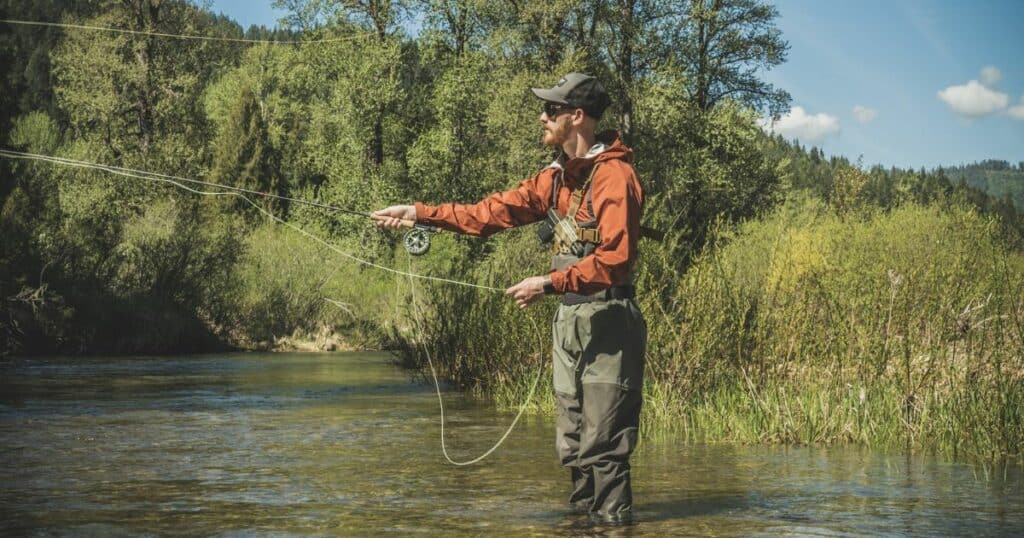
The goal is simple: keep your firearm accessible, out of the water, and secure while you move.
Chest Carry (Most Reliable Option)
Chest carry is the most reliable option because it solves all three problems at once.
- Access – Your firearm stays in the same position whether you’re standing, sitting, or casting.
- Exposure – It sits above the waterline, even when wading deeper.
- Retention – It stays stable through movement, bending, and uneven terrain.
You don’t have to fight your clothing or adjust your body to draw. The position stays the same no matter what you’re doing.
For instance, the Kenai Chest Holster is designed to keep your firearm high, secure, and accessible even with waders, packs, or layered clothing.
If you want one setup that works across most fishing conditions, this is it.
Hip Carry (Situational)
Hip carry can work, but only in the right conditions. It makes more sense when:
- You’re fishing from shore.
- You’re staying mostly dry.
- You’re not wearing bulky layers.
Even then, it only solves part of the problem. Access can be blocked by clothing, and exposure becomes an issue if you step into deeper water.
It’s usable but less forgiving if conditions change.
Pack or Bag Carry (Limited Use)
Carrying your firearm in a pack or bag creates more problems than it solves.
- You may need both hands to access it.
- Your firearm may still be exposed to moisture.
- Risk of being separated from your firearm if you set your gear down.
This setup might feel convenient, but it doesn’t hold up when you need quick, consistent access.
If you want one setup that works across most fishing scenarios, chest carry is the one that checks all three boxes: access, exposure control, and retention.
Setting Up Your Fishing Carry System
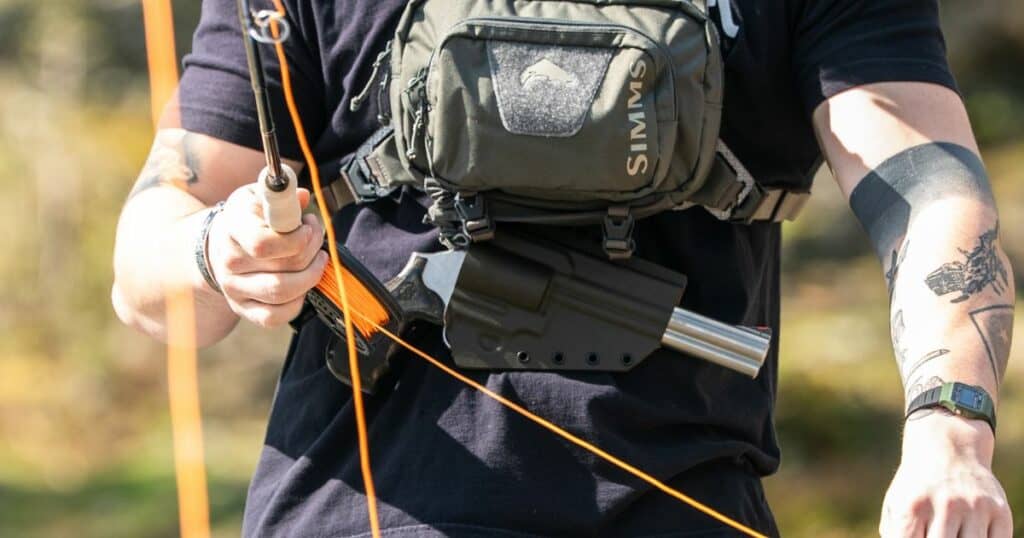
Start with your environment, build around your gear, and then test it in real conditions.
Consider Your Environment
Where you fish changes what works, so your carry position should match how you move in that environment.
- Wading – You’ll deal with water depth, current, and uneven footing. Keep your firearm higher on your body.
- Shore fishing – More flexibility, but still watch for movement and gear interference.
- Boat or kayak – Seated positions matter more. You need access without standing or shifting too much.
Consider Your Gear
Fishing gear can block access fast if you don’t plan around it. Think about:
- Waders and jackets covering your waist
- Packs or chest rigs sitting over your torso
- Rod movement across your body while casting
Everything you wear or carry affects your draw path. Your firearm needs a clear, repeatable path that doesn’t change as you move.
This is where integrated setups help. Systems like the Kenai Chest Holster keep your firearm above the waterline and out of the way of most gear. From there, options like the Bino Link Holster or Tackle Link Holster let you attach your holster directly to compatible chest rigs or packs.
That keeps everything in one place instead of stacking gear on top of each other or creating new obstructions.
For more information, read Tackle-Link vs. Bino-Link, The Tackle-Link Holster: A Game-Changer for Fishing, and Carrying a Pistol with a Bino Harness.
Test Your Access
This is the step most people skip, and it’s the most important.
Ask yourself:
- Can you draw without moving or lifting gear?
- Can you do it with one hand?
- Does it feel the same when standing, sitting, or wading?
- Does your rod or line ever cross your draw path?
If your access changes depending on what you’re doing, it’s not set up right.
Build a Setup That Works on the Water
Carrying a gun while fishing is about making sure your setup still works when the environment changes. Water, movement, and layered gear all add friction. If your setup doesn’t account for that, you’ll feel it right away. The goal isn’t to carry more but to carry in a way that still works when you’re fishing.
If you’re building or adjusting your setup, explore GunfightersINC Holsters designed for real movement and layered gear.
April 27, 2026