




Carrying a firearm while riding an ATV or adventure vehicle isn’t the same as carrying on foot.
What feels comfortable standing still can become awkward or unreliable once you’re seated for miles or bouncing across uneven terrain.
Why Vehicle Riding Changes How You Carry
Your body position, access angles, and movement change, so your carry method has to work while seated, handle vibration, and stay consistent through frequent stops and dismounts.
Because riding changes these fundamentals, you need a different way to consider carry methods.
1) Access While Seated
Can you access the firearm without compromising vehicle control? On an ATV or bike, your hands belong on the controls until you’ve stopped and stabilized.
That means your setup should allow clean access once you’re stopped without awkward twisting, digging under straps, or needing two hands to clear gear. If you can’t reach it safely while seated (or it takes a full-body adjustment), it’s not a great solution even if it feels fine standing.
2) Retention Over Rough Terrain
Does the carry method stay secure during vibration and over uneven terrain? Rough terrain can bounce a holster, shift your beltline, and loosen gear.
Retention isn’t only about “will it fall out.” It’s also about whether the holster stays in the same place so your draw is consistent. If the setup migrates, flops, or changes angle every time you hit a rut, it’s going to create problems.
3) Consistency During Dismounts
Does it stay consistent during dismounts? Frequent on/off transitions are normal with ATVs, side-by-sides, and overland rigs. A good carry method works the same way on the machine and on foot.
If you have to re-tuck, re-clip, re-position, or “fix it” every time you get off, it’s not consistent, and inconsistency is where fumbles happen.
4) Compatibility With Riding Gear and Safety Equipment
Does it interfere with riding gear or safety equipment? If the holster forces you to choose between access and safety gear, it’s the wrong match for vehicle use.
Chest protectors, riding jackets, cold-weather layers, and backpacks can block access or push a holster out of position. Seatbelts and harnesses add another layer that can pin a belt holster or make it harder to reach.
So keep these fundamentals in mind as you decide which holster system works best for you and your adventure vehicle.
Two Carry Approaches for ATVs and Adventure Vehicles
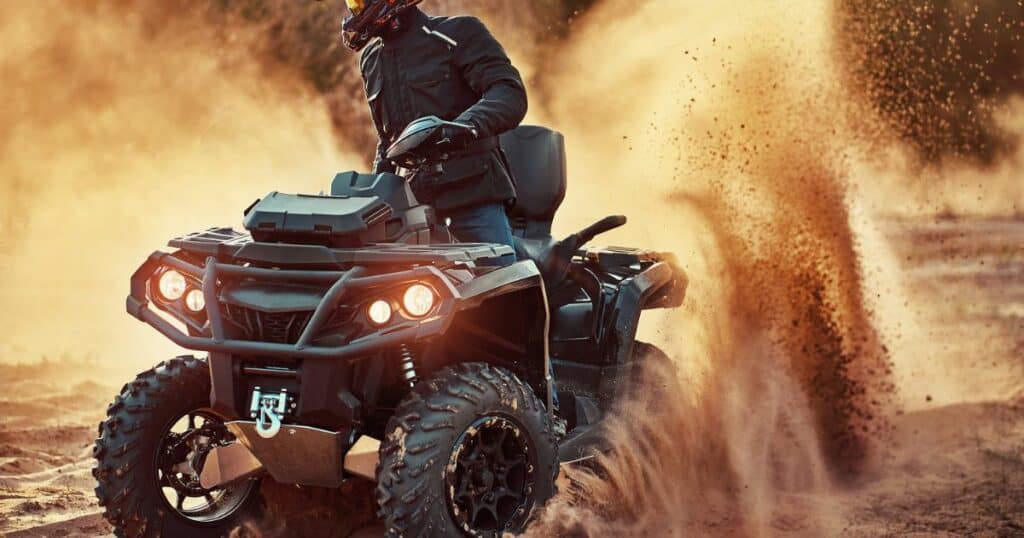
Nearly every ATV or adventure vehicle setup falls into one of two categories. Each approach comes with its own trade-offs in access, retention, and consistency.
On-Body Carry
The first approach keeps the firearm with you, not the machine, so access stays consistent no matter what you’re riding or how often you dismount.
- The firearm stays with the rider. If you dismount, walk a trail, or step away from the vehicle, the gun comes with you. There’s no transition step and nothing to forget or re-secure.
- Consistent access regardless of vehicle. Whether you’re on an ATV, motorcycle, side-by-side, or on foot, your access pattern stays the same. That consistency reduces fumbling during stops and starts.
- Less exposure to dust, mud, and weather. On-body carry keeps the firearm closer to your body and shielded by your gear. Compared to vehicle-mounted options, it’s less likely to take direct hits from mud, water spray, or trail debris.
There are two types of on-body holster styles that handle seated riding and constant movement better than others.
Chest Holsters: Stable, Accessible Carry While Riding
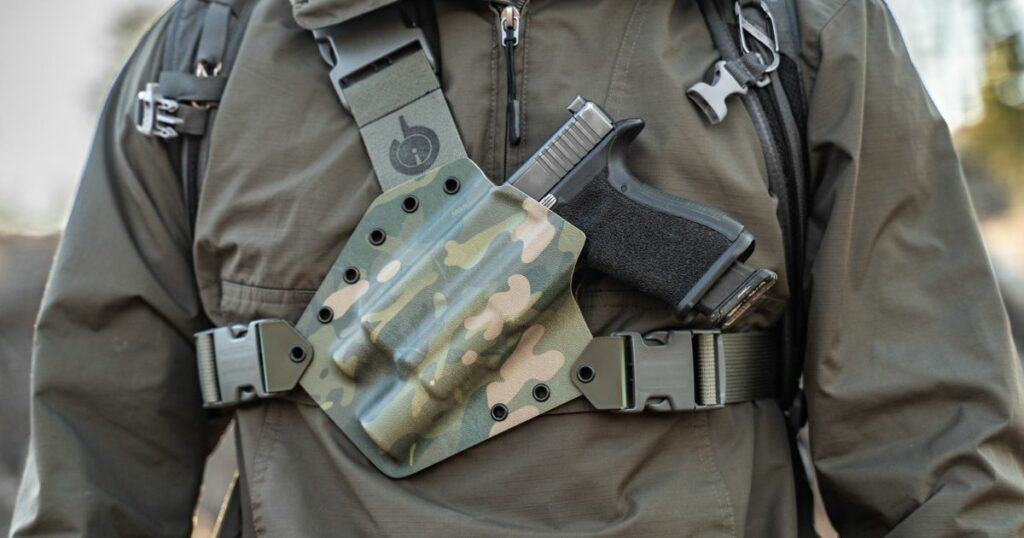
A chest holster keeps the firearm on your body while staying clear of seats, controls, and most riding gear.
Why chest carry works well for ATVs and adventure vehicles:
- Stable in both seated and standing positions. Whether you’re sitting for long stretches or standing on the pegs, chest carry stays centered and doesn’t shift with hip angle or seat pressure.
- Accessible with gloved hands. The draw path stays consistent, even when you’re wearing riding gloves or heavier outer layers.
- Consistent through dismounts and terrain changes. Get on your bike or get off of it, the holster stays put.
- Plays well with rough terrain. Because it’s anchored to your torso, chest carry resists bounce and vibration better than many belt-based setups.
Things to consider:
- Backpack straps and chest armor need to be routed cleanly.
- Binocular harnesses or chest rigs should be integrated, not stacked randomly.
- Fit matters. Too low or too high affects access and comfort.
Chest holster systems like the Kenai Chest Holster are designed specifically for worn carry during movement. And if you have a chest pack, the Bino Link Holster and Tackle Link Holster allow you to use your preferred bino harness or tackle pack as a chest carrier.
Shoulder Holsters: Layered Carry for Cold or Armored Riding
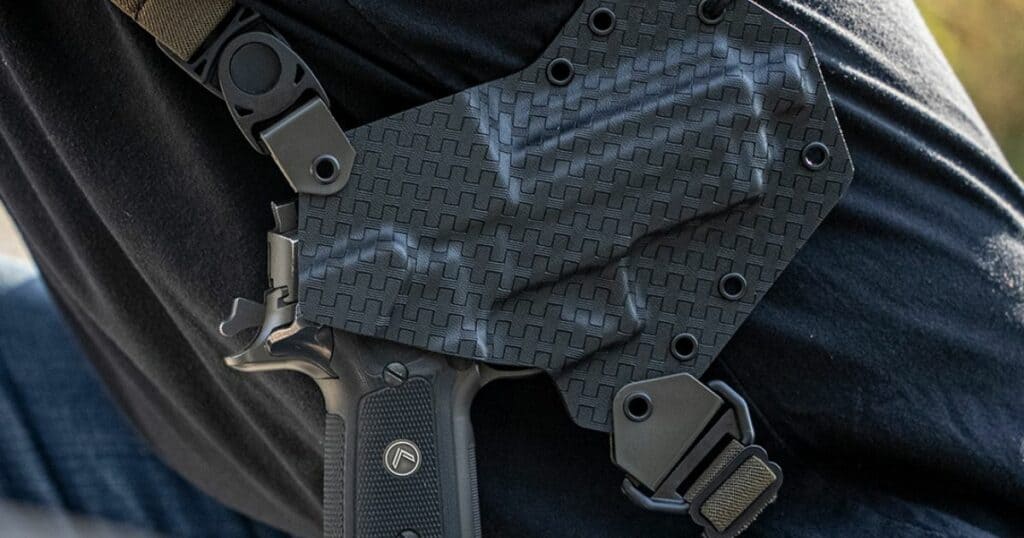
Shoulder holsters are another worn-carry option. They tend to work best when riders are fully layered up.
Where shoulder carry makes sense:
- Cold-weather riding. Shoulder carry keeps the firearm accessible above the waistline when wearing jackets or layers.
- Riding with armor. Some armor setups crowd the belt area. Shoulder carry moves the firearm away from that area.
- Reduced beltline clutter. If you’re already carrying tools, packs, or riding gear on your waist, shoulder carry can free up space.
Things to consider:
- Shoulder systems add material and can trap heat, especially in warmer conditions.
- Access can feel longer or less natural when seated, depending on jacket fit and strap adjustment.
- Strap routing and adjustment matter more here. Poor fit shows up fast on long rides.
Systems like the Spectre Shoulder Holster make sense when layers or armor limit other options.
Vehicle-Mounted Carry
The second approach moves the firearm off the rider and onto the vehicle, trading on-body consistency for situational access in specific environments.
- Firearm attached to the vehicle. The holster or mount lives on the machine, not your body. That means access depends on where you’re seated, how the vehicle is positioned, and whether you’re still on it.
- Can offer fast access in specific scenarios. In controlled use cases, a mounted setup can be quick and intuitive once stopped.
- Introduces retention, exposure, and separation risks. Rough terrain, vibration, weather, and debris all work against vehicle-mounted gear. There’s also the risk of stepping away from the vehicle.
Vehicle-mounted carry isn’t wrong, but it adds variables. That’s why many riders treat it as an option for specific needs and not the default solution.
When Vehicle-Mounted Carry Makes Sense
- Farm or ranch use with frequent on/off transitions. Property work often means short rides and repeated stops. In these cases, a mounted option can provide quick access while moving between tasks (so long as you’re staying close to the vehicle).
- Property patrol scenarios. For perimeter checks or routine patrols where the vehicle remains nearby, mounted carry can make sense as a secondary access point rather than primary carry.
In both cases, mounted carry works best when the vehicle itself is part of the workflow and not when riding distance, terrain, or separation risk increases.
Carry for the Ride, Not the Parking Lot
ATVs and adventure vehicles demand intentional carry choices. Choose a carry method that stays secure, accessible, and predictable based on how you ride, what you wear, and how often you’re on and off the machine.
If you’re dialing in carry for ATVs or adventure vehicles, GunfightersINC has several holster systems built for movement that stay secure, accessible, and consistent while riding.